Centro Andaluz de Biología Molecular y Medicina Regenerativa
Rosario Prados-Carvajal

RNA Metabolism and DNA Repair in Cancer Therapy Resistance

e-mail: rosario.prados@cabimer.es

ORCID: 0000-0003-4721-6311
X: @marpracar
Linkedin: https://www.linkedin.com/in/rosario-prados-phd-53a587106/

Overview

Cancer cells rewire RNA metabolism to survive genotoxic stress and escape treatment, and this rewiring can also be turned against them. Our research focuses on the crosstalk between RNA metabolism and the DNA damage response, and on how manipulating this crosstalk can revert drug resistance in cancer. We study the molecular determinants that shift a cancer cell from resistance back to sensitivity toward DNA-damaging agents and targeted inhibitors, with the long-term goal of defining combination strategies that can resensitize resistant tumors in the clinic.

Current research lines

1. Determinants of PARP inhibitor (PARPi) resistance in BRCA-deficient cancers

PARP inhibitors exploit a concept known as synthetic lethality: tumor cells deficient in homologous recombination (HR) rely on PARP enzymes to cope with the DNA damage that accumulates when this repair pathway is not available. Blocking PARP activity overwhelms these cells with unrepaired damage that they cannot resolve, while cells with intact HR remain largely unaffected (Figure 1). This selectivity has transformed the treatment of breast, ovarian, pancreatic and prostate cancers with HR deficiencies. However, tumors frequently find ways to restore their ability to tolerate DNA damage, and acquired resistance to PARP inhibitors remains one of the main obstacles to durable responses in the clinic.
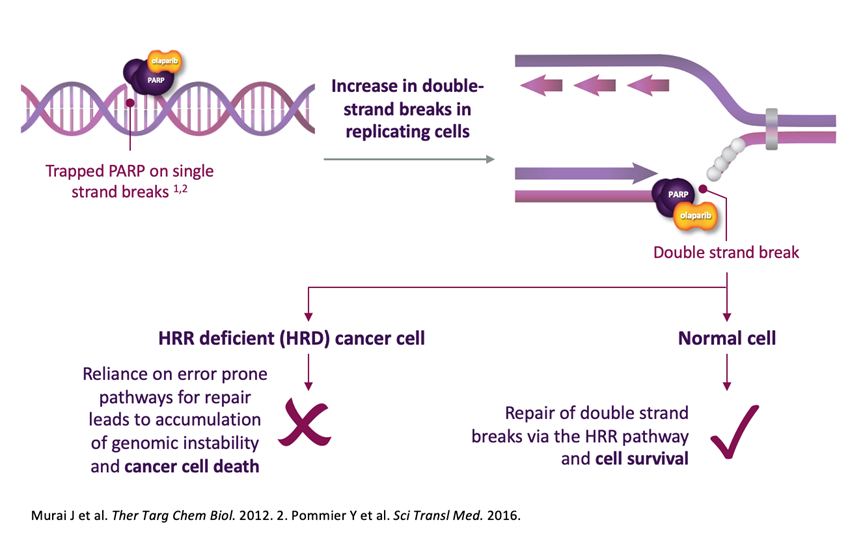
Figure 1. Mechanism of PARP inhibitor action in HR-deficient cancer cells. PARP inhibitors such as olaparib trap PARP on single-strand DNA breaks, preventing its release and increasing the load of double-strand breaks encountered during replication. In HR-deficient (HRD) cells, these breaks cannot be repaired accurately and instead accumulate through error-prone pathways, driving genomic instability and cancer cell death. In cells with intact HR, the same breaks are efficiently resolved and cell survival is preserved.

Our work explores how factors involved in RNA metabolism shape the balance between sensitivity and resistance to PARP inhibitors in BRCA1/2-deficient cancer cells, where BRCA proteins are central to HR. We are investigating how these factors affect the way cells handle DNA damage and the signaling pathways that connect DNA repair to cell survival, with the aim of identifying vulnerabilities that can be exploited pharmacologically. One of the central determinants we are studying is the ADAR family of RNA-editing enzymes, whose activity influences how BRCA-deficient cells respond to DNA damage and to PARP inhibitor treatment. Our goal is to define how modulating RNA-metabolism pathways, can help resensitize resistant, BRCA-deficient tumors to PARP inhibitors, and to translate this into rational combination strategies.

2. Reverting resistance to KRAS-targeted therapy in lung and pancreatic cancer models

Oncogenic KRAS is one of the most frequent drivers of lung and pancreatic cancer, and resistance to KRAS-targeted therapies is a growing clinical problem. RNA-metabolism factors determine how oncogene-driven tumors respond to KRASG12C inhibitors. In resistant non-small cell lung cancer (NSCLC) and pancreatic ductal adenocarcinoma (PDAC) models, depletion of specific RNA-editing enzymes bidirectionally alters KRAS mRNA and protein levels through post-transcriptional mechanisms. This project aims to exploit these mechanisms as entry points to resensitize resistant tumors to KRAS-targeted therapy.

Projects as Principal Investigator:

  1. Exploiting the Radioadaptive Response to Improve Radiotherapy. Junta de Andalucía. Co-Principal Investigator.
  2. Exploring the molecular associations of ADAR and KRAS and their therapeutic implications in lung and pancreatic cancer. AECC Sinergias. SNRGS247052PRAD. Principal Investigator.
  3. Role of ADAR-mediated RNA editing in different BRCA-deficient tumor cells. AECC Postdoctoral Grant. AECC_POSTD222709PRD. Principal Investigator.

Projects as Researcher:

  1. CCAR2: at the crossroads of DNA repair, cellular metabolism and stress signaling. PID2022-136791NB-I00. Plan Estatal, Ministerio de Ciencia e Innovación. 2023-2026.
  2. Molecular characterisation of olaparib resistant in BRCA2-mutant cells.AstraZaneca. 2020-2022. Principal leader
  3. Regulation of DNA break repair by the circadian clock. P18-RT-1204. Junta de Andalucía. 2020-2022.
  4. New insights on Aicardi-Goutières Syndrome, a novel connection with DNA repair. Fundación Ramón Areces. 2019-2022.
  5. Regulation of recombination in the cell context. SAF2016-74855-P. Plan Estatal, Ministerio de Economia y Competitividad. 2017-2019.
  6. Relationship of S-Phase Damage and Segregation Defects in Mitosis in Recessive Syndromes with Microcephaly. P12-BIO-515. Junta de Andalucía. 2014-2017.
  7. Regulation of the processing of double-stranded breaks in DNA and its implication in tumor development. SAF2013-43255-P. Ministerio de Economía y Competitividad. 2014-2016
  8. Relevance of double-strand break repair pathway choice in human disease and cancer. ERC Starting Grant. 20212-2016

A complete list can be obtained at https://orcid.org/my-orcid?orcid=0000-0003-4721-6311
  1. Rosa Camarillo*, Rosario Prados-Carvajal* et al. (1/8). 2025. DNA Topoisomerase IIß inhibition blocks DNA end resection and synergizes with PARPi in BRCA1-deficient models. DNA repair. 152:103866. *co-first authorship
  2. Guillermo Rodríguez-Real, Andrés Domínguez-Calvo, Rosario Prados-Carvajal et al. (3/7). 2023 Centriolar subdistal appendages promote double-strand break repair through homologous recombination. EMBO Reports 24:e56724. Ranked 41/191 Q1 in Cell Biology
  3. Rosario Prados Carvajal; Elsa Irving; Natalia Lukashchuk; Josep Forment. (1/ 4). 2021. Preventing and overcoming resistance to PARP inhibitors: a focus on the clinical landscape Cancers. 14-1, pp.44. Ranked 60/245 Q1 in Oncology. (Review)
  4. Sonia Jimeno*; Rosario Prados Carvajal*; María Jesús Fernández Ávila; et al;. (1/17). 2021. ADAR-mediated RNA editing of DNA:RNA hybrids is required for DNA double strand break repair Nature Communications. 12-5512. *co-first authorship. Ranked 4/79 Q1-D1 in multidisciplinary sciences
  5. Rosario Prados Carvajal; Guillermo Rodríguez Real; Pablo Huertas. (1/ 3). 2021. CtIP – mediated alternative mRNA splicing finetunes the DNA damage response RNA. 27, pp.303-323. Ranked 93/295 Q2 in Biochemistry & Molecular Biology
  6. Judit Domingo Prim; Martin Endara Coll; Franziska Bonath; Sonia Jimeno; Rosario Prados Carvajal; Marc R. Friedländer; Pablo Huertas; Neus Visa. (5/ 8). 2019. EXOSC10 is required for RPA assembly and controlled DNA end resection at DNA double-strand breaks Nature Communications. 10-1, pp.2135. 3 . Ranked 6/71 Q1-D1 in multidisciplinary sciences
  7. Sonia Jimeno; Rosa Camarillo; Fernando Mejias Navarro; Maria Jesus Fernández Ávila; Isabel Soria Bretones; Rosario Prados Carvajal; Pablo Huertas. (6/7). 2018. The Helicase PIF1 Facilitates Resection over Sequences Prone to Forming G4 Structures Cell Reports. 24-12, pp.3262-3272. Ranked 29/193 Q1 in Cell Biology
  8. Rosario Prados Carvajal; Ana López Saavedra; Cristina Cepeda García; Sonia Jimeno; Pablo Huertas. (1/5). 2018. Multiple roles of the splicing complex SF3B in DNA end resection and homologous recombination DNA repair. 66-67, pp.11-23. Ranked 20/93 Q1 in toxicology
  9. Gonzalo Hernández; María José Ramírez; Jordi Minguillón; Paco Quiles; Gorka Ruiz-de Garibay; Miriam Aza-carmona; Roser Pujol; Rosario Prados Carvajal et al; (9/26) 2018. Decapping protein EDC4 regulates DNA repair and phenocopies BRCA1 Nature Communications. 9-1, pp.967. Ranked 5/69 Q1-D1 in Multidisplinary sciences.
  10. Michal Gavish Izakson; Bhagya Bhavana Velpula; Ran Elkon; Rosario Prados Carvajal et al; (4/ 11). 2018. Nuclear poly(A)-binding protein 1 is an ATM target and essential for DNA double-strand break repair Nucleic Acids Research. 46-2, pp.730-747. Ranked: 14/298. Q1-D1 in Biochemistry & Molecular Biology.